Guildhall Cambridge: the Food and Drink Stalls on Cambridge Market Square
There has been a market on this square since before the university existed. The Guildhall stands on its southern side, the stalls fill the rest of it, and the food traders occupy one edge. It is the oldest continuously working thing in Cambridge and the most useful single place to eat in the city centre.
On this page What and where Which days How the stalls work Night market
What and where
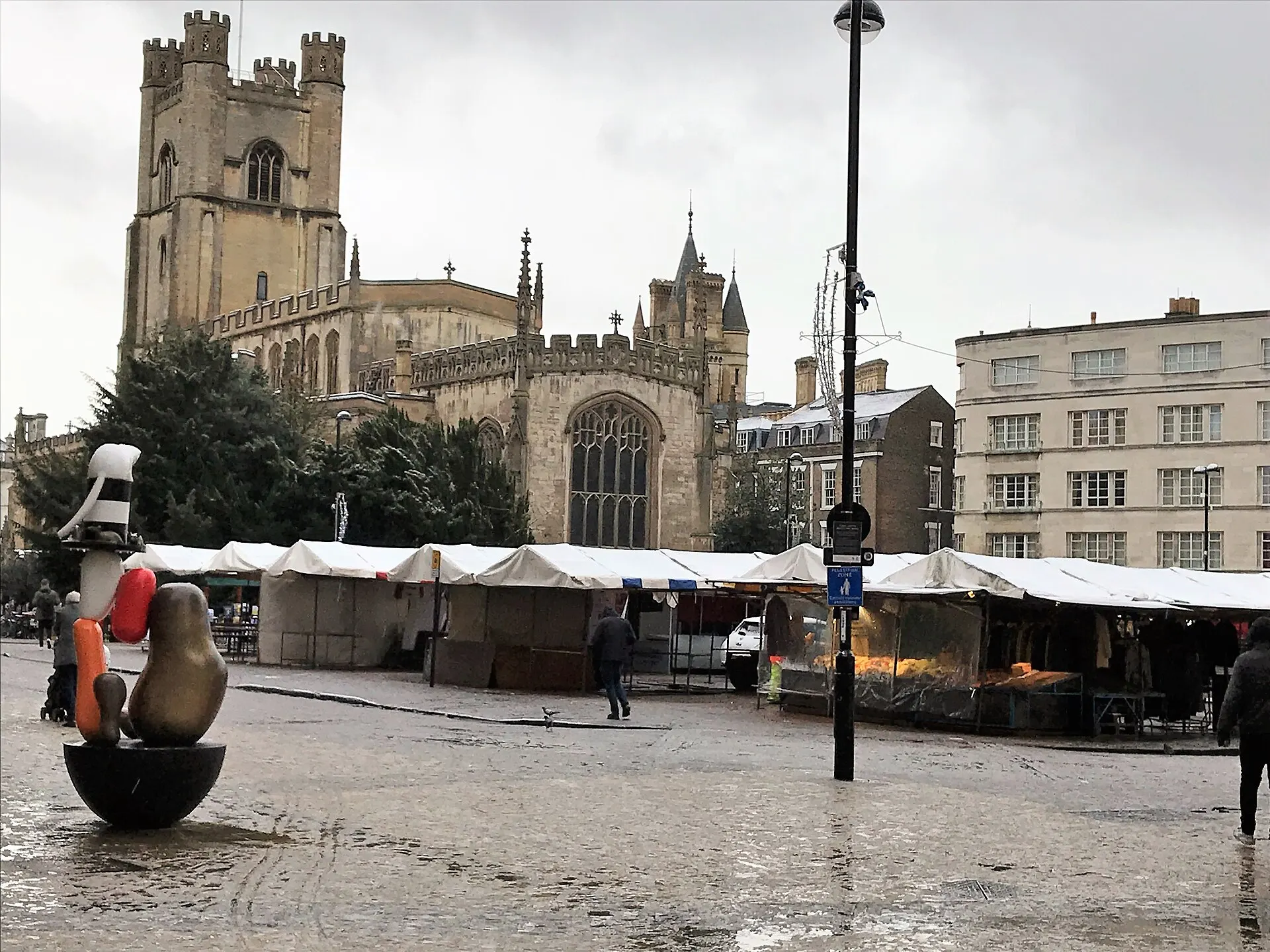
Cambridge market square sits in the exact middle of the city, bounded by the Guildhall to the south, Great St Mary's church to the west and shops on the other two sides. Everything central is within five minutes of it. The market trades in the open air under permanent canopies, seven days a week, in all weather.
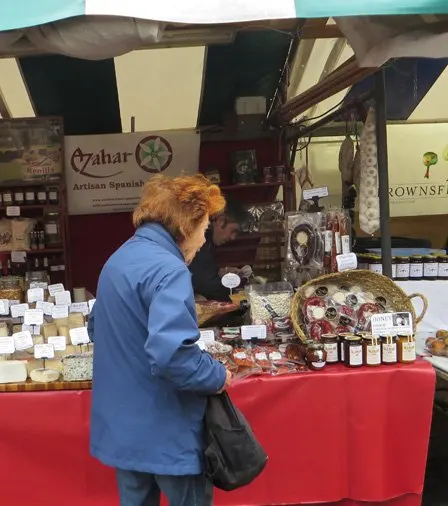
The stalls divide roughly into three: fresh produce and food to take home, hot food cooked on the spot, and everything else — books, clothes, bicycle repairs, plants, cut flowers. The food traders are not segregated into a separate zone, but they cluster, and you will find them by following the smell, not a sign.
Which days
Every day. The council trades the market on all days except Christmas Day, Boxing Day and New Year's Day, which makes it the one piece of Cambridge eating you cannot turn up to on the wrong day. The mix is not identical from morning to morning — stalls take days off, and the balance between hot food, produce and the non-food trades shifts with the season and the weather — but the square is working whenever you get there.
Trading is daylight-shaped. Stalls set up early, the serious lunch trade runs from around midday to two, and traders begin breaking down in the middle of the afternoon. Arriving at four means a reduced choice; arriving at four also means produce traders clearing stock, which is the cheapest food in Cambridge.
How the food stalls work
A market stall is a different business from a restaurant and it produces different food. The constraints are real: limited power, limited water, no room for a large fridge, and a pitch that has to be set up and taken down every day. What survives those constraints is a small number of dishes, cooked repeatedly, extremely well.
That is why the best market food anywhere tends to be narrow. A trader who sells one thing has made that thing several hundred times this month. It is also why the prices hold up against the high street despite the central location — a stall's overheads are a fraction of a shopfront's on the same square.
Most traders take cards now, though a few are cash-preferred and the signal is usually a handwritten sign and not a terminal on the counter.
Guildhall Cambridge: the building itself
The building on the south side is the city's civic hall, rebuilt in the 1930s on a site that has carried a guildhall since the thirteenth century. It is a working council building with public halls used for concerts, exams, fairs and elections, and it gives the market its name, not the other way round.
For anyone eating, the practical point about Guildhall Cambridge is the steps and the low walls along the square's edges: that is where people sit with market food, and on a dry lunchtime every inch of it is occupied.
Night market Cambridge: what it is and is not
A night market Cambridge visitors are often looking for — a permanent evening street-food operation of the kind Manchester or Bristol run — does not exist here as a fixture. What the city has instead is periodic evening trading on the same square, announced in advance and run for a particular season or occasion, most often around Christmas and in the warmer months.
When they happen, these evenings use the market square's existing infrastructure, with a different line-up of traders and a bar. They are genuinely good and they are genuinely occasional. Anyone planning a trip around a Cambridge night market should check the current listings rather than assume, because the pattern changes year to year.
The reason the city has no permanent night market is the same reason it has little late-night food generally: a small, heavily protected centre, a residential population immediately behind the shopfronts, and licensing that reflects both.
Buying produce rather than lunch
The part of the market that visitors use least and residents use most is the fruit, veg, fish, cheese and bread. Cambridgeshire is serious arable and market-garden country — the black fen soil north of the city is among the most productive farmland in Britain — and a good deal of what is on the stalls has travelled a very short distance.
Prices beat the supermarkets on most things in season and lose on anything out of it, which is the honest trade. Shopping the market well means buying what is piled high.
Cambridge Market Square through the year
The square changes with the calendar more than the rest of the city does. Soft fruit in early summer, a glut of orchard fruit and squash in autumn, brassicas and roots through the winter, and a thinner, colder market in January and February when the fen has little to give. Christmas brings extra trading and a different crowd.
Weather matters more here than anywhere else in this guide. The canopies keep rain off the stalls but not off you, and a wet February lunchtime on Cambridge market square is a miserable business. On those days the covered options around the edge of the square earn their keep.
Eight centuries on one square
Cambridge grew around a river crossing and a market, in that order, and the square has been the commercial centre of the town since the Middle Ages. The university arrived in the early thirteenth century into a place that was already trading, which is the reverse of how the city is usually described.
The square's present shape is relatively recent. A fire in the middle of the nineteenth century destroyed a dense block of buildings that stood in the middle of it, and the space was cleared and opened out rather than rebuilt. The fountain that followed, and the canopied stalls that came much later, sit in ground that was once houses. That history is why the market is unusually large for an English city centre and why it has never been moved indoors.
Guildhall Cambridge as a name covers both the civic building and, by extension, the market in front of it. The two have been linked administratively for centuries: the city runs the market, licenses the pitches and maintains the square.
Getting there, and getting there sensibly
The square is in the pedestrianised core, which means the honest answer to how to reach it is on foot. It is roughly twenty minutes' walk from the main railway station, ten minutes from the bus station at Drummer Street, and a few minutes from almost every central college.
By bike it is faster still, and there is cycle parking around the edges of the square that fills by mid-morning. Driving into the centre is possible and rarely worth it: the Grand Arcade and Park Street car parks are the nearest, both charge city-centre rates, and the Park and Ride sites on the edge of the city are cheaper and usually quicker door to door.
Access across the square itself is level and the surface is even, which is not something that can be said for much of the medieval centre. Getting between stalls in the middle of a busy lunchtime is the harder part.
Who trades here
Pitches on Cambridge market square are licensed by the city council, and the mix is deliberately managed, not left to whoever turns up. That is why the market has not turned into eight stalls selling the same thing, and it is also why new traders wait.
Some of the businesses here have held a pitch for decades and are second-generation. A few started on this square and went on to open shops elsewhere in the city, which is the market's quiet function: it is the cheapest way to test a food business in an expensive town. Several well-known Cambridge food names began with a stall.
If you are interested in trading, the council publishes the licensing terms and runs the waiting list. Casual pitches exist alongside permanent ones, which is how a trader tests the square before committing to it, and how the occasional night market Cambridge runs is staffed.
How it compares with the rest of Cambridgeshire
The county has several good markets and they are not interchangeable. Ely runs a market in the shadow of the cathedral with a strong produce showing and a noticeably different crowd. St Ives has one of the oldest charters in the country. The smaller fen towns run weekly markets that are closer to the agricultural original than anything in Cambridge.
What Cambridge has that the others do not is frequency and footfall. Daily trading in a city centre with this many people walking through it supports a density of hot-food trading the market towns cannot, which is why Cambridge market square is the one you go to for lunch and Ely is the one you go to for vegetables.
A note on the night market question
This page gets found by people searching for a night market Cambridge does not permanently have, and it is worth being direct rather than letting them travel on a guess. The evening events are real, well run and genuinely worth attending — they are simply periodic. Anyone planning around one should confirm the dates from the organiser before booking anything, because they move.
The daytime market, by contrast, is as close to a certainty as this city offers. It will be there tomorrow, as it was eight hundred years ago.
Using the market well
Three habits separate people who use this market from people who visit it. Walk the whole square once before buying anything, because the stall you want is rarely the first one you pass. Go at the edges of the day rather than at one o'clock, when the queues are shortest and the traders have time to talk. And buy what is abundant instead of what you came for.
For anyone new to the city, the market is also the fastest way to learn what Cambridgeshire actually grows and when. A month of paying attention to what is piled up on the produce stalls teaches more about the local food year than any amount of reading, and it costs nothing to look.
Guildhall Cambridge is, in the end, an ordinary working market in an extraordinary setting, and the ordinariness is the point. It is where the city buys its dinner.
Questions people ask
Is the Cambridge market open every day?
Every day except Christmas Day, Boxing Day and New Year's Day. The mix of stalls varies from day to day, but the square is trading whenever you get there.
What time does it close?
Trading is daylight-shaped and stalls break down through the middle of the afternoon. Come before two for the full choice, or late for cleared-stock prices on produce.
Is there a night market in Cambridge?
Not as a permanent fixture. Evening markets run periodically on the same square, announced in advance, most often seasonally. Check current listings before travelling for one.
Where can I sit and eat market food?
The steps and low walls around the square, or Great St Mary's churchyard beside it. Five minutes further and you have the Backs and the river.
Where to go next
For the wider picture, see places to eat in Cambridge. For traders away from the square, street food in Cambridge, and for the rhythm of the year, what's on in Cambridge.