The festival of shrimp
Oostduinkerke, on the Belgian coast, is the last place in the world where people fish for shrimp on horseback. The practice is on the UNESCO list of intangible cultural heritage, and the town's shrimp festival exists because of it.
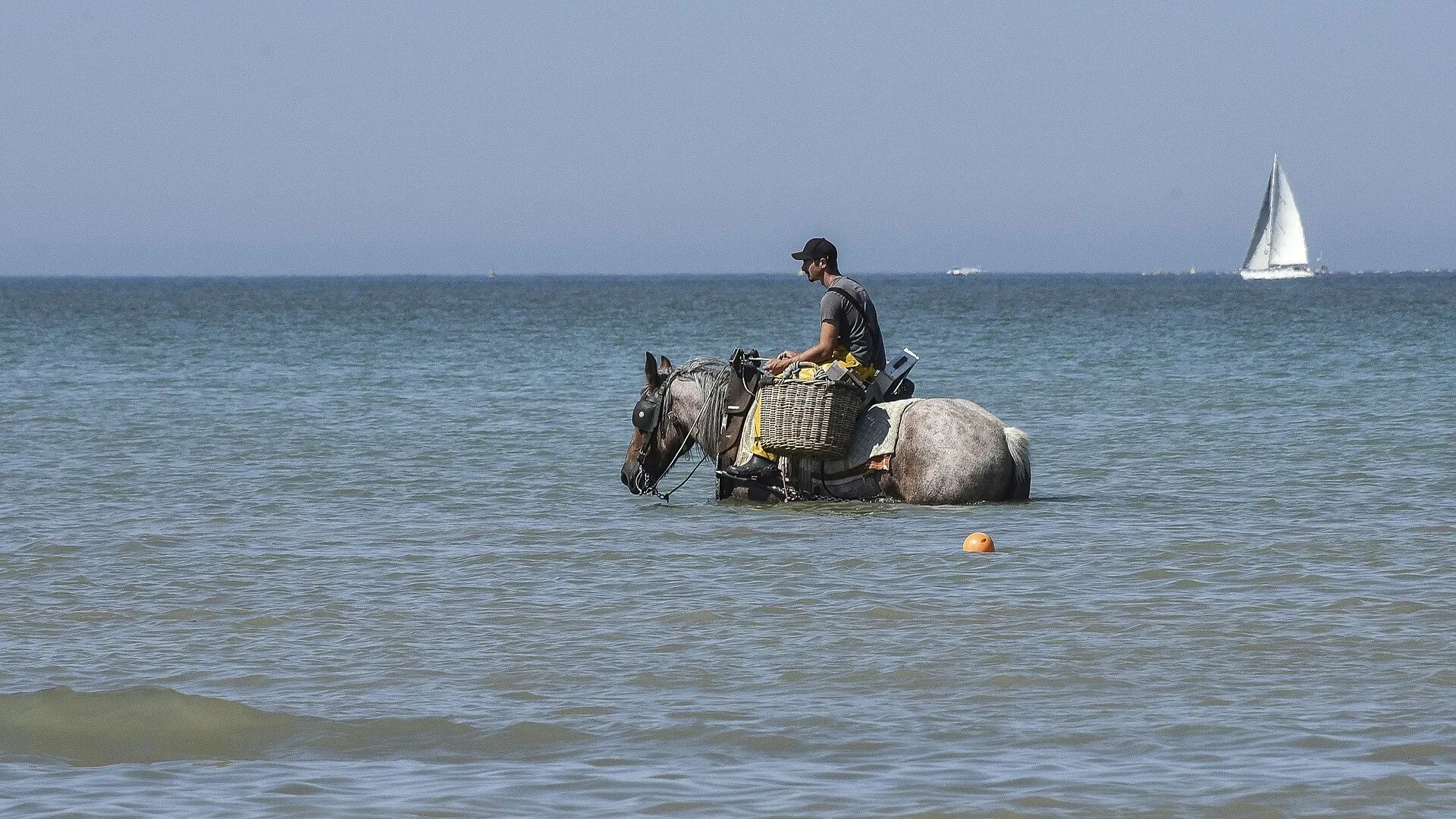
Fishing from the saddle
The method is straightforward and very old. A Brabant draught horse walks breast-deep through the surf, parallel to the shore, pulling a funnel-shaped net held open by two wooden boards. A chain dragged over the sand sets up a vibration, and the shrimp jump off the bottom and into the net. The fisherman rides, watches the water and tips the catch into baskets hung at the horse's sides.
It works only on a shallow, gently shelving beach with the right currents, which is why it survived in one place and nowhere else along a coast that once had many. The fishing is done twice a week outside the winter months — not daily, not on demand, and not for a boat's worth of catch.
UNESCO's listing counts twelve households in Oostduinkerke actively engaged in it, each with a speciality of its own: one family weaves nets, another holds the deep knowledge of the horses. That division matters more than it sounds. The practice is not one skill held twelve times over; it is several skills distributed across twelve households, and losing any one of them is a different kind of loss from losing a fisherman.
The transmission is informal and deliberate. Experienced shrimpers demonstrate the technique and pass on what they know about nets, tides and currents to beginners, and UNESCO describes the group as functioning on shared values and mutual dependence. The qualities it names are a good knowledge of the sea and of the sand strip, and a high level of trust in and respect for the horse — which is a short way of saying that this is an animal-handling craft as much as a fishing one.
The practice was already on the Flemish inventory of intangible heritage in 2009, four years before the international listing, and the NAVIGO museum in the town carries formal responsibility for safeguarding it. Recent reporting puts the number of active fishermen at around fifteen and notes that none of them makes a living from it. The horseback fishery is not a small industry. It is a practice kept alive by people with other jobs.
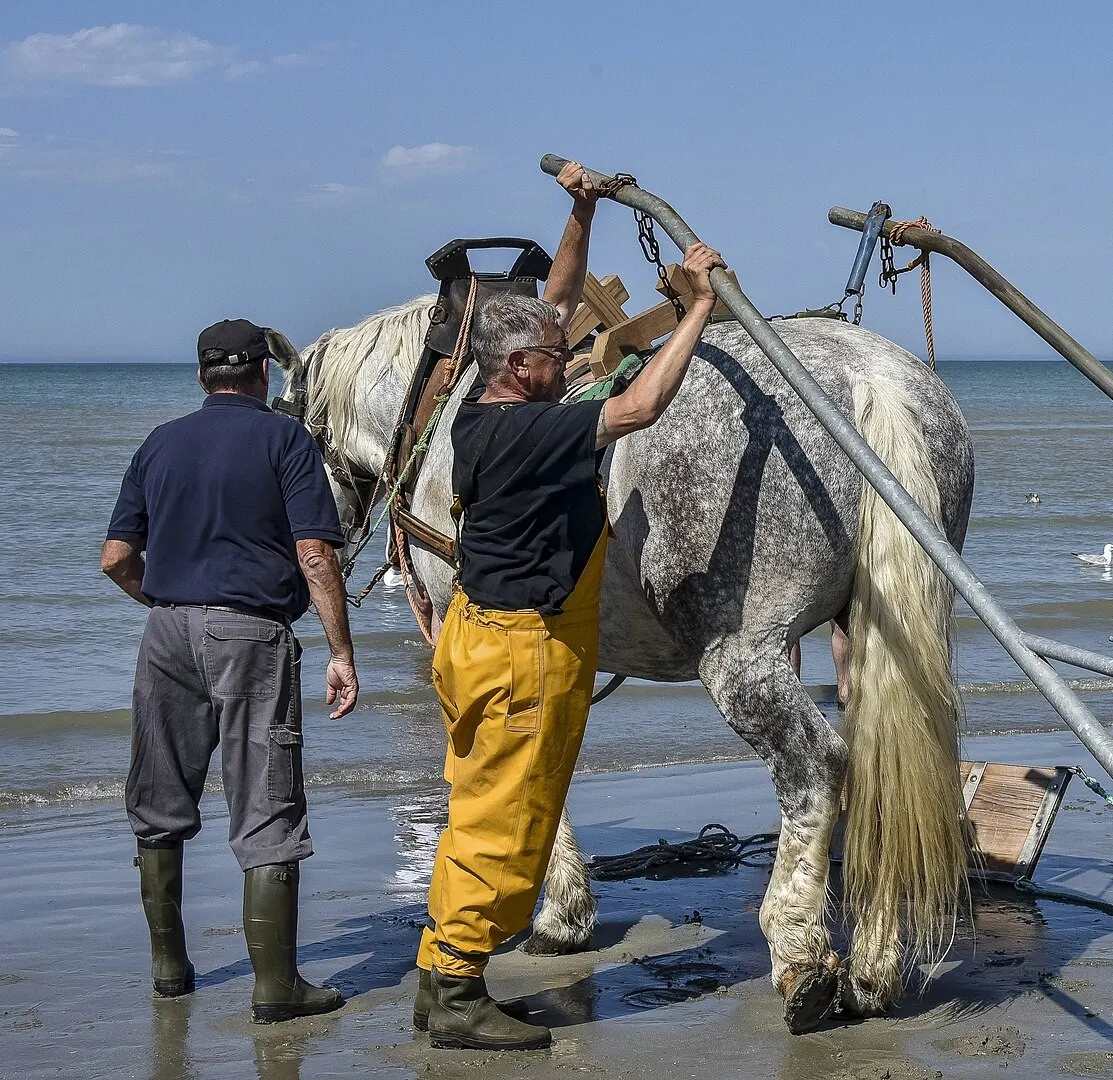
The festival
The town's shrimp festival runs over two days, and UNESCO's own description of it is the most revealing thing on the listing: the local community spends months building floats, preparing street theatre and making costumes. The parade and a contest in which hundreds of children are initiated into shrimp catching draw over ten thousand visitors a year.
Read that back and the proportions are extraordinary. Months of unpaid preparation by a small coastal town, for two days, for a visitor count that a mid-sized British food festival would consider modest. The festival is not a marketing exercise that happens to involve locals; the preparation is the community activity, and the two days are its public face.
The children's contest is the part worth stealing. A festival that teaches hundreds of children to catch shrimp is not celebrating a tradition, it is recruiting for one. That is a different objective from putting on a good weekend, and it is measurable over a generation, not over a season.
The rest of it is a great deal of grey shrimp eaten in the simplest possible way: boiled in seawater, peeled by hand, on bread. The point of the event is to keep the practice viable, not to scale it up — and the distinction is visible in what the festival does not do. There is no attempt to turn twelve households into forty.
Grey shrimp, and why they are worth it
The North Sea grey shrimp — the brown shrimp of the fishmonger's slab — is small, sweet and a great deal of work. A portion is hundreds of individual animals, each of which has to be peeled by hand, and no machine has historically done it as well as fingers.
That single fact has reshaped an entire European fishery. Most of the shrimp caught in the southern North Sea is trucked through the Netherlands to Morocco, where the peeling centres are, hand-peeled there, and shipped back to Europe to be sold. Most of the EU's peeling capacity sits in Morocco. Older trade reporting put the round trip at about ten days for something still sold as fresh, and the re-import requires validated catch certificates proving where the shrimp came from in the first place.
It is one of the cleanest illustrations in European food of a labour cost deciding a supply chain. Nobody designed a system in which a North Sea shrimp travels to North Africa and back before it is eaten in Ostend; it is simply what happens when the processing step is human and the labour rate differs enough. The industry has been working on machines to bring the peeling home — partly on efficiency grounds, partly because there is measurable willingness to pay for a shrimp peeled where it was landed.
Which is the whole economic argument for Oostduinkerke in one sentence. A shrimp caught from a horse, boiled on the beach and peeled by the person selling it has not been anywhere. That is not nostalgia; it is a ten-day difference in the age of the thing you are eating, and the sweetness is the first thing that goes.
Other shrimp and prawn festivals
Shrimp turns out to be a common thing to build a festival on, which makes sense: it is caught close to shore, it is landed in quantity on a short season, and it is cheap enough to feed a crowd. Almost every shrimping coast has an event of some kind. What differs is what the event is for.
The obvious comparison sits on the Gulf coast of the United States. Morgan City in Louisiana holds the Louisiana Shrimp & Petroleum Festival over the Labor Day weekend, and it is usually described as the oldest state-chartered harvest festival in Louisiana. It began in 1936, when the ports of Morgan City and Berwick took in their first boatload of jumbo shrimp, as a single day on which a Catholic priest blessed the boats on the Atchafalaya River.
The name acquired its second industry in 1967, as offshore drilling grew around the same river mouth. A festival that had been about a catch became a festival about a catch and an oilfield, because those were the two things the town did. There is something bracing about a community naming its event after both of its employers without attempting to reconcile them.
Set the two side by side and they are doing opposite jobs. Morgan City celebrates industries that are large, mechanised and in no danger of being forgotten. Oostduinkerke is maintaining a practice that twelve households carry and that would end within a generation if it stopped being taught. The Gulf event is a harvest festival in the old sense; the Belgian one is closer to a working apprenticeship with a parade attached. Both are honest about which they are, which is more than many events manage.
What heritage listing actually does
The 2013 inscription on the Representative List of the Intangible Cultural Heritage of Humanity carries no money and no legal protection. What it carries is attention, and attention is double-edged for a practice this small. More visitors mean more income for a town that needs it; they also mean pressure on twelve households to perform twice a week for an audience rather than fish for a catch, and at least one account has described the activity as having become largely a show for tourists.
That tension is not resolvable and it is not unique here — it is the standing problem of every listed living practice. The honest position is that a tradition with twelve households and no one earning a living from it was going to end without outside interest, and that outside interest changes what it is. Oostduinkerke chose the version that survives.
There is a second lesson in it for anyone running a food event somewhere ordinary. The thing Oostduinkerke protects is not a dish and not a recipe — it is a method, held by named households, that could not be reconstructed from a book if it stopped. Most towns have something of that kind, usually unglamorous and usually unrecorded, and it is almost never the thing the local festival is built around. Festivals tend to be built around what photographs well.
Eating shrimp well
Cold, freshly peeled, with bread and butter and nothing else. Anything that arrives already peeled and sauced has travelled, and the sweetness is the first thing that goes.
In Britain the equivalent is the potted shrimp of Morecambe Bay, which solves the same problem a different way: butter and spice as a preservative and not a sauce, because the shrimp had to reach the inland market somehow. Two coasts, one small sweet animal, and two entirely different answers to the question of how to get it to someone before it stops being worth eating.